

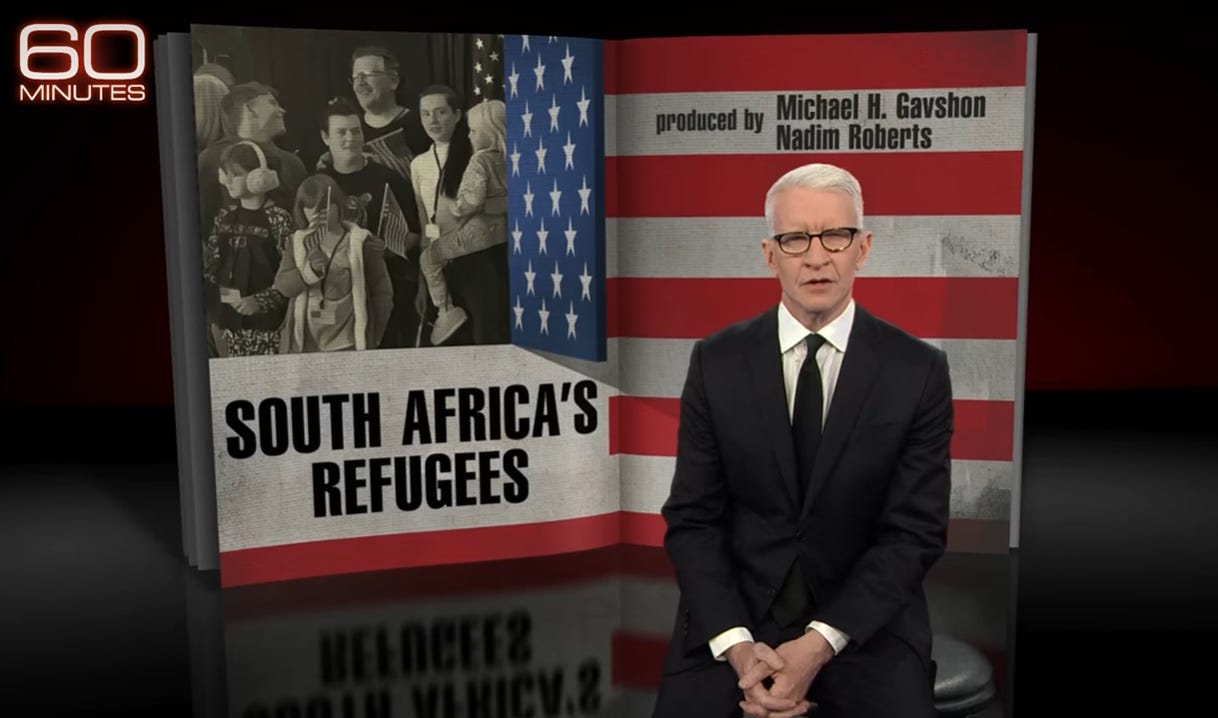
On Sunday, February 22, 2026, 60 Minutes aired a story on the plight of South African farmers. I was curious — I’ve actually followed this issue since the late 2010s; more on that below — and I consider myself on the right end of the bell curve.
So I watched.
If you haven’t seen it, here it is. Give it a watch and then let’s walk through it.
The Setup: It’s Happening, But It’s Not a Big Problem
I first learned of the 60 Minutes piece on X — where, let’s face it, the February 22, 2026 traffic has been a glorious combination of Gold Medal USA memes and bloody, toothless hockey heroes — and the X excerpt — “Xcerpt” I guess; boy I’m clever — was from the first few minutes of the piece.

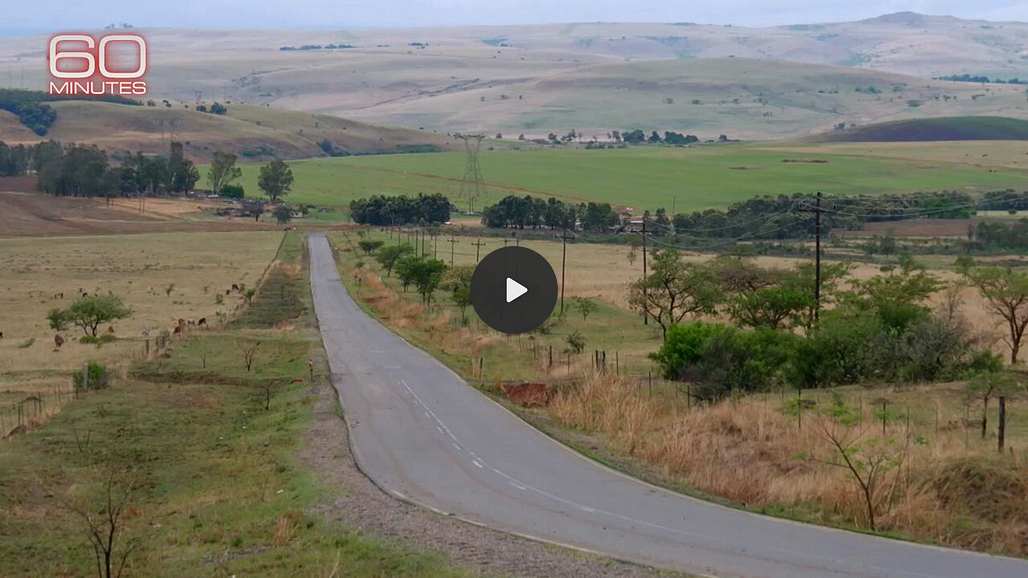
Cooper wastes no time in framing the story as “not that big of a deal;” and the tweet accompanying the Xcerpt is akin to the first play from scrimmage being a 60-yard pass from the QB to the top receiver.
“In May, Pres. Trump said ‘over a thousand’ White farmers have been murdered in South Africa.” Trump claimed the crosses were “marking their burial sites.” The white crosses, the tweet tells us, “were gone.”
The story opens with some interesting foreshadowing, as they tell us that the interview subject, Daryl Brown, is a “seventh-generation rancher and farmer.” This is foreshadowing because we see that Brown’s family has tended the land since the Apartheid days. Stay tuned for that part of the story.
An Introduction to Being ‘Directionally Correct’
Trump’s mission with his use of the phrase “burial sites” was what the late Scott Adams would call “anchoring.” Get people to pay attention to an issue by exaggerating the claim; then, when the exaggerated claim is proved false, you have begun to get people to pay attention to the issue.
It’s from that where I get the concept of being “Directionally Correct.” If you claim “Thing One Is Everywhere,” and the other side says “Thing One Isn’t Everywhere, Here Are A Couple Examples, But It’s Not Everywhere,” you have been shown to be Directionally Correct. You’re not completely accurate, but you’ve now gotten me to pay attention to an issue that, while perhaps minor, is indeed happening.
The mission of 60 Minutes appears to be getting the issue to be framed as a combination of deep-seated scars from Apartheid — what we would call “systemic racism” in the USA — and also the fact that —Oddly? Coincidentally? Ironically? — “All Lives Matter!” But they acquiesce to the fact that Trump and others who have been talking about South African Farm Murders are at least Directionally Correct.
Cooper sets out to disprove point the first point: “They’re Not Burial Sites!” He succeeds in the first couple minutes, and can declare victory. The end zone is near, time to maybe establish the run game for a couple plays, or just throw over the middle for a nine-yard gain to the tight end.
‘I’m Just Asking Questions’
Journalists, YouTubers, X Power Users, Comedians: they all use the “I’m Just Asking Questions” excuse to ask, frankly, stupid questions.
It’s done for the camera, or for clicks, and some of it will elicit the typical eye rolls. But Anderson Cooper’s question to the South African farmer at roughly the 4-minute mark of the video was bonkers.
The setup (with apologies for any misspellings; I’ve taken the spelling of each name from the closed captions on YouTube) is that Daryl Brown’s friend Toli Nell was murdered on his farm. Toli’s wife, Renee, witnessed the murder and still lives on the farm. (Her son, Tiennes, tends the farm and we learn that he carries a firearm with him everywhere, he tells Cooper, but in the shower.)
Having debunked the “burial sites” argument, Cooper can move down the scale from “It’s not happening” to “It’s happening, but it’s not that big a deal.” He does so in the stupidest way, with the question at 4:00 of the video. “When you heard President Trump talk about a genocide, what did you think?”
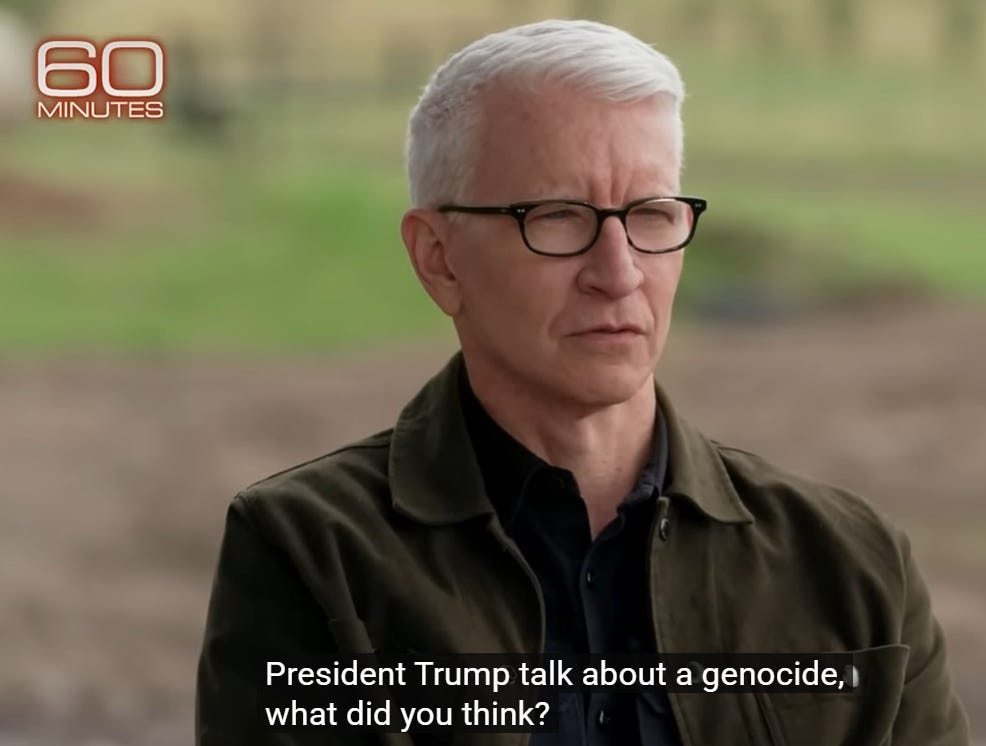
I won’t blame Renee Nell, the widow, for her response here. (I’m not here to dogpile on grieving widows, that’s the domain of Candace Owens.) She told Cooper that she thought Trump was using the wrong word, then she said that the attackers were being “opportunistic.”
I don’t know the other questions that were asked here, so I will give Cooper the benefit of the doubt on that. HOWEVER, using the response of one grieving widow to paint a broad brush stroke over something that is happening, and has been reported on for going on ten years now, but is being swept under the rug as “not a big deal” is beyond the pale.
Time to Pivot to Journalistic Malpractice
No matter what she said, actually, Cooper was ready to pivot to the most-plausible narrative from anyone to the Left on any issue such as this.
I’ll call it the “Short Skirt” argument, which is the one usually thrown out to try to defend an indefensible sexual assault charge with the “well, she shouldn’t have been wearing a ‘short skirt’” defense. E.g. “They were asking for it.” Ridiculous, blames the victim, should never be used to justify a crime. Ever.
Fade from Renee Nell to what eerily reminded me of Charlie Brooker’s Newswipe “How to Report the News” piece (link below).
We see average Afrikaners at a table, followed by an establishing shot of a farm, followed by people working on said farm.
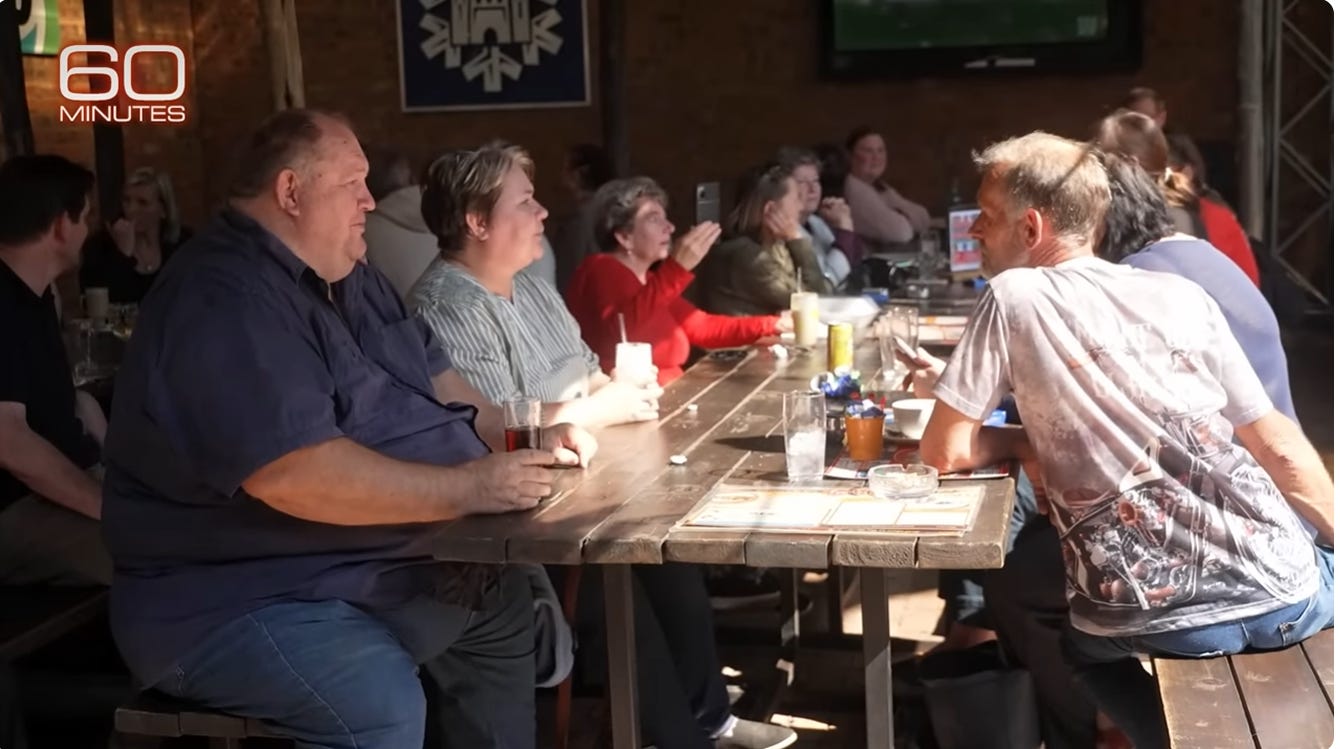
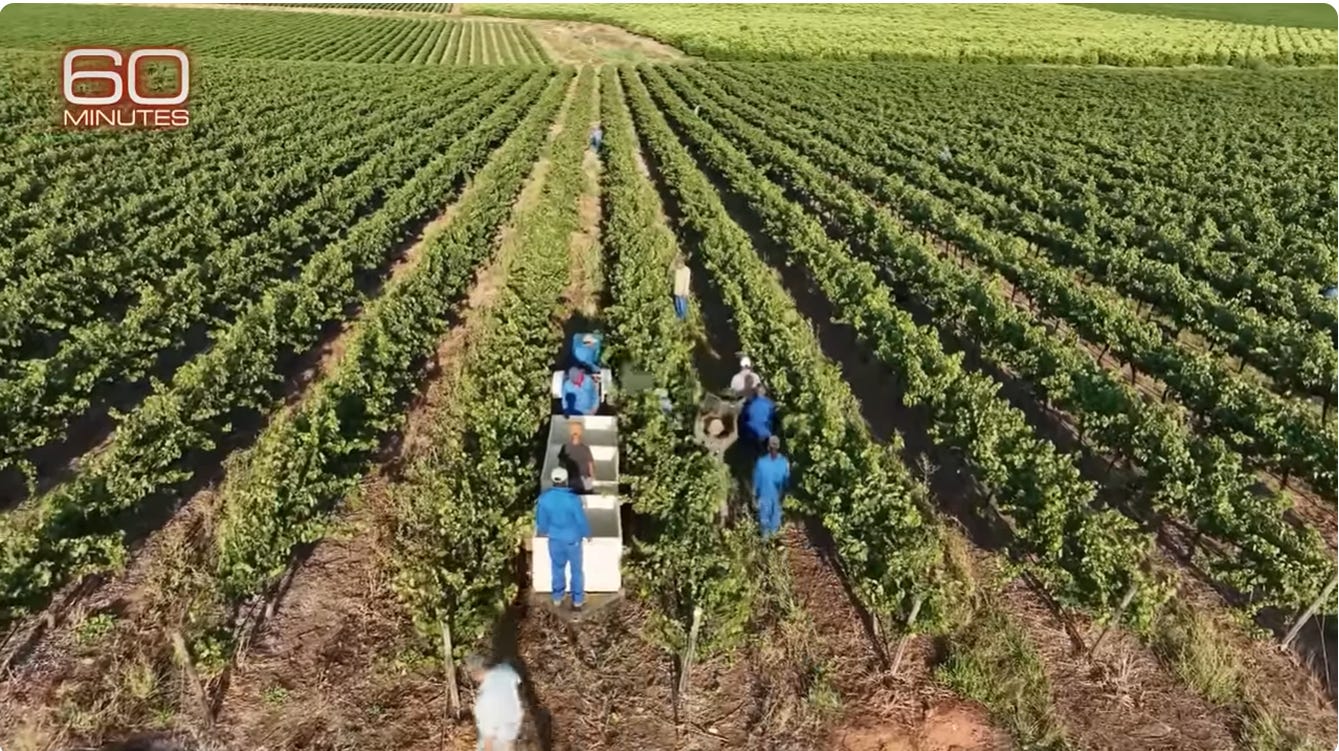
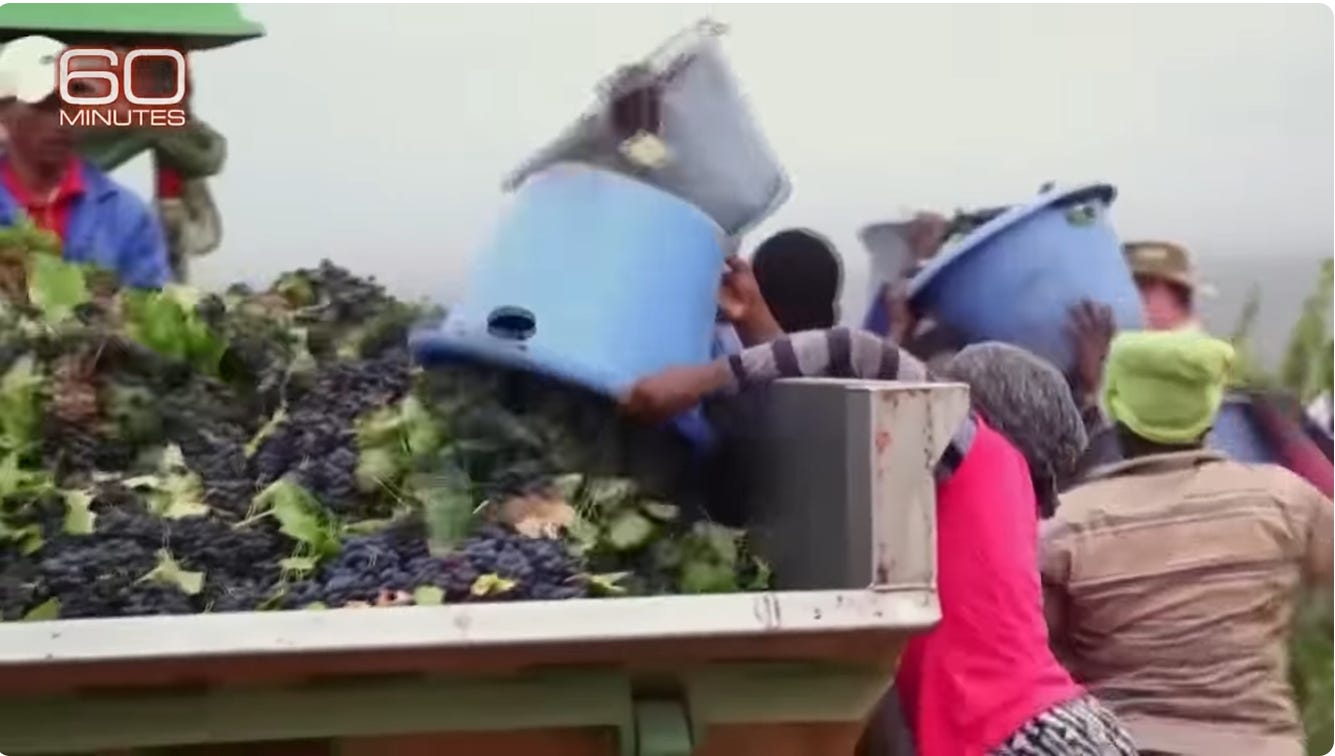
But it’s the line that accompanies these shots that will stop you in your tracks. It’s the Short Skirt Argument:
“Whites make up only about 7 percent of the population of South Africa, but still own 72 percent of all privately held agricultural land, and many of the country’s large commercial farms.”
Yes, it is directionally correct to say that if only 7 percent of the population owns 72 percent of its farms that is an example of inequality. (It’s also a fact that Price’s Law is a thing and the square root of the number of people in an organization will be responsible for 50 percent of its productivity.)
Cue the (Black) South African “leading agricultural economist,” a chap called Wandeli Salobo, to tell us that, yes, the Whites own 72 percent of the farms but, quoting Cooper here, “the overwhelming number of farmers and those working on farms are Black.”
Quoting Salobo now:
“The White farmers may have a bigger part of the proportion of income, but the vast majority of people operating the farms in South Africa are Black.”
What follows is as formulaic as Brooker’s Newswipe piece — though not at all funny — in that Cooper and his CBS producers show us a Black farmer who was forced to sell his 9-acre farm because he was shot at (by whom, we aren’t told), then we’re shown footage of a presumed murder victim, behind police tape, and we’re told by Cooper that the murder rate in South Africa is “seven times that of the United States.” And that 25,000 murders took place in 2024 but an “estimated 37 of them were killed on farms.”
‘Crime, Boy I Don’t Know’
There’s a memorable scene from The West Wing that comes to mind. The TL;DR version of it is that the President is running for re-election, he has an off-the-record discussion with his opponent, his opponent says a really stupid line, and the President throws the line back in his face.
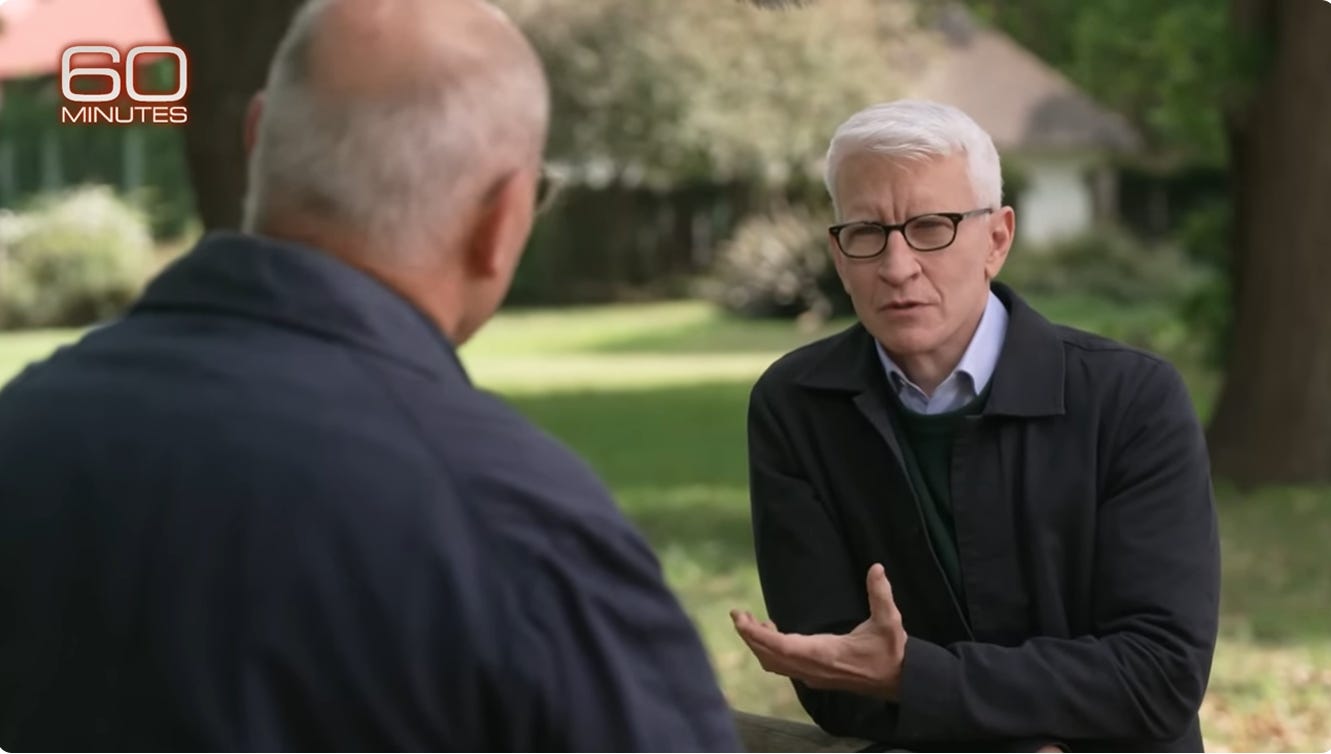
Cooper next interviews an individual named Johan Kotza (again, apologies for the spelling errors; the CC machine also calls them “Africoners” so that’s not correct either), who heads up “South Africa’s largest agricultural organization.” Kotza says it’s not about White genocide but “it’s about criminality in South Africa.”
Cooper’s inelegant response/question would have caused the fictitious President Bartlet to light up another cigarette:
“That’s what’s happening on farms. That’s what’s happening in streets in Johannesburg and in other major cities. It’s crime.”
CBS then tells us that published statistics only began giving the race of those murdered on farms beginning in 2025, and the first quarter of 2025 found 6 murders on farms, with only 1 of those six being White.
(Hold on, let me brew some more coffee. My brain hurts from the amounts of circular logic necessary to understand where Cooper et al are going with this. And we’re only halfway through. Subscribe button follows.)
Why Is Any of it Happening?
Having been told by Kotza that poverty drives crime, we next see more establishing shots of South Africa’s inequality, followed by a few more stats and info-nuggets that fit the narrative:
44 percent of Blacks live in poverty
only 1 percent of Whites live in poverty
2.7 million residents of South Africa are “Afrikaners,” who settled 400 years ago
1948 was when Apartheid was instituted, stripping Blacks of any rights whatsoever
1994 is when Blacks were at long last able to vote
Nelson Mandela was elected, ushering in a new system of democratic rule.
Cooper next tells us of the progress that has been made, with a growing Black middle class, and a reduction in poverty among all Blacks in the country.
Next, the all-too-predictable one-two punch of (1) using the fact that American “white supremacists” talked about South Africa at rallies and (2) Fox News talked about it when Tucker Carlson worked there to paint the people pointing out the problem as racists.
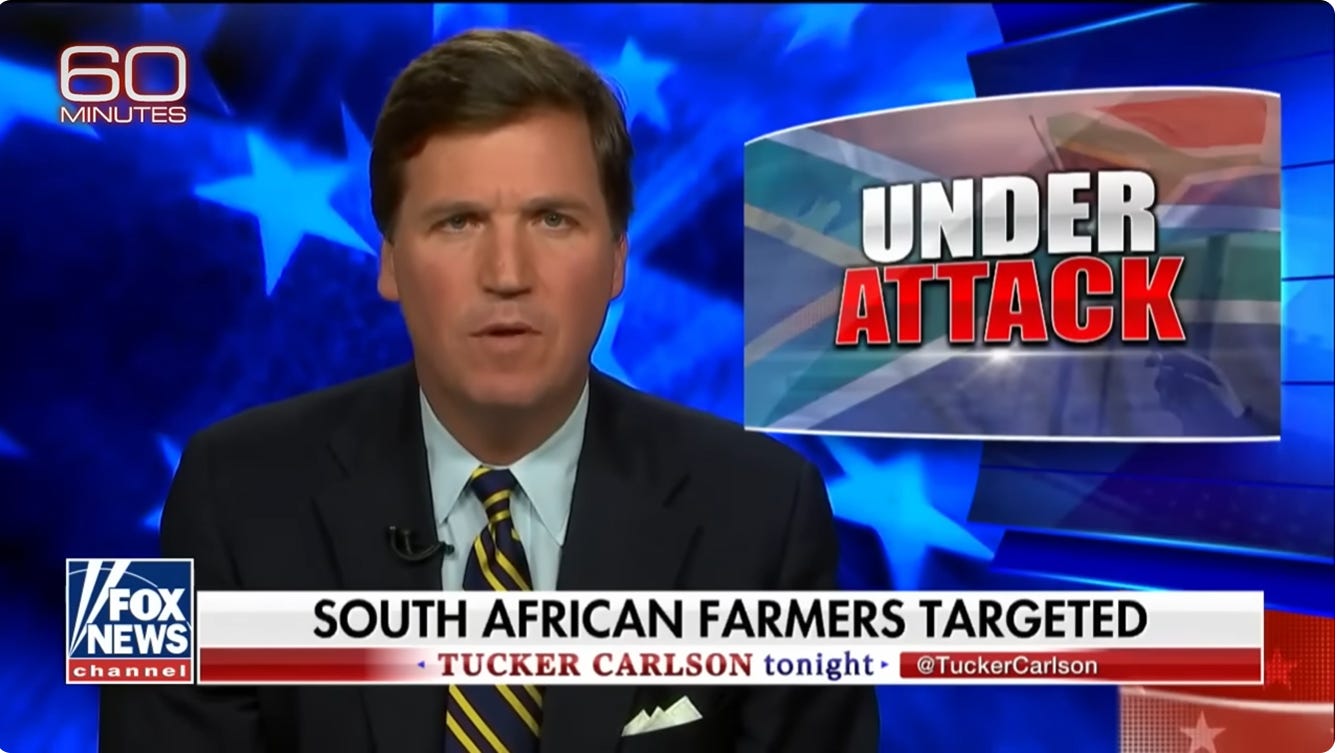
It was 2018, during the first Trump Administration, when the “Farm Murders” argument — according to 60 Minutes — first took off. Cooper next asked a journalist named Max du Preez whether this was happening; the confusing nature of the questioning and the framing made it seem that du Preez was waving off everything, as the exchange was…well…here’s the exchange:
Cooper: “Are there large scale killings of farmers…”
du Preez: “There are not…”
Cooper: “…and is the government seizing land?”
du Preez: “they are n—…it is not happening. Donald Trump was fed this information…this link…farm murders…genocide…There is no such a thing.”
[D]u Preez having successfully dismissed the issue, it’s time to move on to the other ideas, right? That’s what 60 Minutes proceeded to do; the rest of the story continued in a similar formulaic way:
Cooper talks about “Expropriation Without Compensation”
It’s not happening yet, though, and if it does it’s going to wind its way through the courts
Cooper interviews Kallie Kriel, a White farmer and head of the group Afriforum, asks him if there’s a “White genocide”
White farmer says “we don’t use that term” but there are farm murders and “we’re seeing a call to genocide.”
Cooper plays video of the chant “Kill the Boer, Kill the Farmer” being played at an rally of the Economic Freedom Fighters party — the video that is widely used as evidence of, at the least, anti-White sentiment — and Cooper does NOT note that the party owns 39 of the 400 seats in South Africa’s National Assembly. (To be fair, Cooper does call Julius Malema a “race-baiting, opposition politician.”)
A back-and-forth ensues, where Kriel is asked whether expropriation without compensation has actually taken place; Kriel responds by saying no, but adding “because the old legislation did not allow it. The new legislation allows it.”
Time for more from du Preez, and a discussion of the fact that 59 Afrikans were allowed asylum into the USA by an executive order from President Trump; and a predictable quote from du Preez, when talking about the USA’s approach to the issue:
“They’re saying that White lives are worth more than other lives.”
An Exhausting Watch
The story closes with a return to Daryl Brown, the White farmer and the guy whose crosses started this whole thing, right? I mean, had he never even planted all the crosses on the roadside, then Trump wouldn’t have called them “burial sites,” and would have never…
If You Give a Pig a Pancake, amirite?
The upshot appears to be that 60 Minutes is trying to tell us, in effect, some combination of the following:
Yes, violence against White farmers is a problem, but a small one;
South Africa is a violent country;
Inequality is everywhere in South Africa;
People are being murdered on farms but most of them are White;
Apartheid started all this;
Don’t tell us that “White Farmer Lives Matter” because that’s racist and wrong;
The government hasn’t taken farms yet, so maybe you Americans should focus on your own issues.
Two Videos to Wrap Up
One is an excerpt from an interview I conducted with Marc Moschetto of The Rational Workforce; Marc turned the tables on me and asked how to navigate through various social media storms. My point (it’s a 2 minute, 45 second excerpt) is that seeking out opposing arguments and different viewpoints is healthy. Here’s the video:
I share that here because I fear that 60 Minutes doesn’t really do that. I’m also wondering if the agenda under new CBS News chief Bari Weiss is to push the envelope just enough to make it look like you’re sharing both sides, but to mislead in the process.
Which brings me to the second video, Lauren Southern’s 2018 documentary Farmlands.
I first watched it when it came out. I was floored; I did more research and it appeared to be more than a tempest in a teapot. Granted, it’s a documentary; documentaries are almost always one-sided.
But if you get the chance and want to know more about the other side of the issue, here’s the video.
Wrapping Up
This is probably one of the longest articles I’ve ever written. And I realize that even touching some of these third rails will get me in trouble.
But I have to ask CBS News, 60 Minutes, the producers, and Anderson Cooper what…exactly…they’re trying to accomplish with this piece? Debunk rumors? Make Trump look bad? Paint White farmers as racist?
It’s tilted, stilted, and doesn’t do the complete story of modern South Africa any justice at all.